
Case Studies
Zero to Telehealth MVP in 90 Days: Custom Telehealth Platform Development Blueprint
Launch a HIPAA-ready MVP in 90 days. Master the exact architecture for scheduling, WebRTC, EHR sync, and provider dashboards.


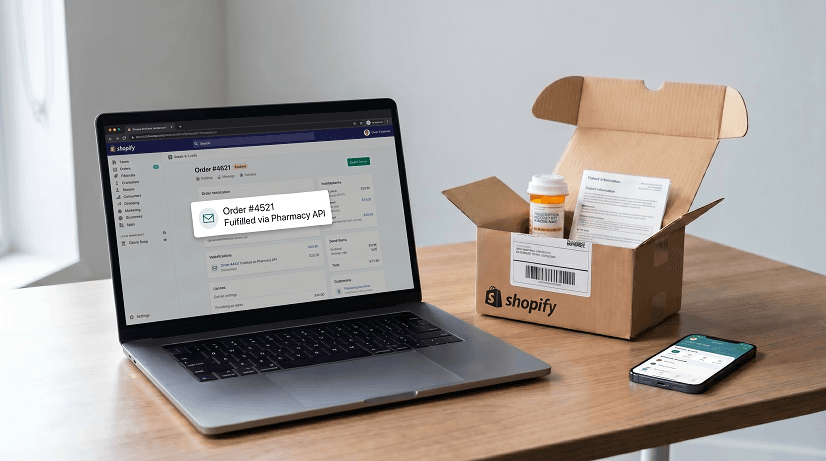
Most DTC health brands on Shopify reach the same point: order volume grows, the pharmacy fulfillment process does not scale with it, and someone on the team spends an increasing share of their week moving data between systems by hand.
For one of our clients, that looked like 47 hours of manual fulfillment work every month. Someone exported CSVs from Shopify, reformatted them to match their pharmacy partner’s required fields, and uploaded them by hand. Every step introduced a new failure point. Error rates climbed as volume grew. Correcting those errors consumed more time than the original process had.
This article covers how we built the HIPAA-ready middleware layer that replaced that process. From kickoff to go-live: three weeks. Manual fulfillment work: near zero. Fulfillment error rate: reduced by more than 90%. Once fulfillment is automated, the next lever is recurring revenue: see how we handle Shopify prescription subscription automation.
The default pharmacy fulfillment approach for Shopify stores is manual data transfer. An order comes in, someone exports it, reformats the fields to match the pharmacy system’s requirements, and uploads the file. When volume is low, this works. When volume grows, three problems emerge.
Error rate compounds with order count. Manual data entry at high volume produces mismatches: wrong quantities, missing patient identifiers, duplicate submissions. Each error requires a correction cycle that takes time the operations team does not have.
Staff time becomes the bottleneck. Forty-seven hours per month is more than a full work week spent moving data that a middleware layer could route automatically. That is a headcount cost with zero leverage.
PHI exposure risk increases at every manual touchpoint. Every step where patient health information leaves Shopify and enters another system without a controlled, audited pathway is a compliance risk. Manual processes produce no audit trail and no consistent access log.
The underlying issue is architectural, not operational. There is no integration layer connecting the two systems. Data does not move automatically, does not validate in transit, and leaves no record linking what Shopify captured to what the pharmacy received.
The solution is a HIPAA-ready middleware layer positioned between Shopify and the pharmacy fulfillment system. Instead of a person moving data between systems on a schedule, the middleware moves it automatically the moment an order is placed, with validation and logging built into the pipeline.
When a qualifying order is placed in Shopify, a webhook fires immediately. The middleware receives the order payload and validates it against the pharmacy partner’s required fields: patient information, product SKU, quantity, and shipping details. Orders that pass validation are formatted and submitted to the pharmacy system without human involvement. Orders that fail validation are flagged and routed to a review queue with the specific failure reason attached.
Nothing is silently dropped. The operations team sees every exception and the reason for it.
Patient health information moves through the middleware layer, not through Shopify directly. Shopify is not a BAA-covered platform for PHI. The middleware infrastructure runs on BAA-covered services, so every PHI transmission stays within a compliant data boundary. Access is logged at each stage. Nothing exits the pipeline without an audit record that captures who touched the data, when, and what the system did with it.
When the pharmacy system accepts or rejects a submission, the middleware captures that response and writes it back to the Shopify order record. The operations team sees real-time fulfillment status inside Shopify without logging into a separate pharmacy system. Rejections surface with the exact error code so the correction takes seconds, not hours of investigation.
The result is a single automated flow replacing a five-step manual process. The client’s fulfillment team went from managing a spreadsheet pipeline to reviewing a short daily exception queue.
Shopify pharmacy fulfillment automation is more straightforward than it looks at the design stage. Several decisions have a disproportionate impact on how reliable the integration is once real orders run through it.
If your team is spending meaningful hours each month on manual pharmacy order exports, the bottleneck is architectural.
We build HIPAA-ready Shopify integrations for health brands that connect Shopify to pharmacy fulfillment partners, ePrescribing systems, and EHR platforms through a compliant, auditable middleware pipeline.
Every engagement starts with a scoping session where we map your current order flow, identify the PHI touchpoints, and define the exact integration scope. You leave with a requirements document and a data flow diagram before any development begins. The NDA is signed before we see your clinical data. No development starts before the scope is locked.
The DTC health brand we built this integration for went from 47 hours of monthly manual fulfillment work to near-zero in three weeks.
Shopify pharmacy fulfillment automation is an infrastructure decision, not a product feature. The right architecture moves order data automatically, validates it at every step, keeps PHI within a compliant boundary, and surfaces exceptions before they become batch problems.
The three outcomes that matter: manual work goes to near zero, error rates drop substantially, and every patient data transmission has an audit trail. The timeline is short because the integration scope is defined precisely before development begins.
If your pharmacy fulfillment process still depends on CSV exports and manual uploads, we can scope the integration for your specific pharmacy partner and order volume. Book a discovery call and we will walk through exactly what the architecture looks like for your store.