Shopify Pharmacy Integration
How to Integrate MD Integrations Into Your Telehealth Store
MD Integrations connects your store to licensed doctors. See what the official plugin covers, what you still build, and how to launch compliantly.


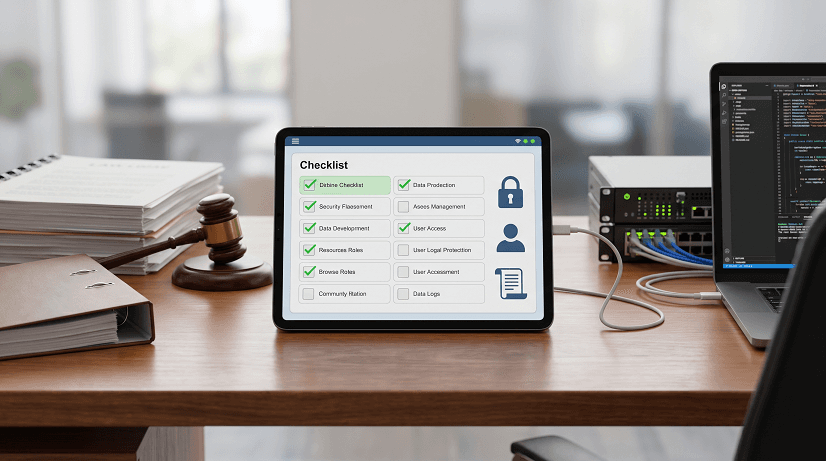
Most founders know they need HIPAA compliance the moment a hospital procurement team asks for a Business Associate Agreement. What nobody tells you is how that legal requirement translates into actual engineering decisions, access policies, and vendor selections. Skipping even one item can trigger six-figure fines, breach notification obligations, and lost enterprise deals. The right hipaa compliance checklist closes that gap between legal obligation and operational reality. You will learn the 12 items that matter, how to verify each one, and where most teams silently fail.
A hipaa compliance checklist is a structured inventory of 12 operational controls that prove you handle protected health information according to federal requirements. It converts vague legal language into verifiable engineering and policy decisions.
Most founders assume HIPAA compliance means signing a BAA and calling it done. The reality is that a BAA is a legal prerequisite, not a compliance outcome. The checklist forces you to verify encryption, access logging, incident response, and vendor risk management across your entire stack. Without this operational layer, you are exposed the moment an auditor or enterprise buyer asks for evidence.
The Office for Civil Rights increased enforcement actions by 40 percent over the last two years. OCR now audits smaller vendors, not just hospital systems. Meanwhile, enterprise procurement teams require documented compliance before they will even schedule a technical review. If you are building anything that touches patient data, provider workflows, or payer integrations, the window to get compliant before it blocks revenue is closing.
Non-compliance penalties range from $100 to $50,000 per violation, with annual caps reaching $1.5 million. Beyond fines, breach notifications average $4.45 million in total cost when you factor in legal fees, customer notification, and reputational damage. Enterprise deals worth $200,000 to $2 million in annual contract value stall indefinitely without documented compliance. The checklist is the difference between a blocked pipeline and a closed deal.
A hipaa compliance checklist outperforms generic security frameworks because it maps directly to the specific data types, access patterns, and audit requirements that healthcare regulators and enterprise buyers actually evaluate.
Many startups complete a SOC 2 Type II audit and assume it covers HIPAA. SOC 2 validates general security controls. It does not address protected health information handling, minimum necessary access rules, breach notification timelines, or the specific technical safeguards that OCR inspectors look for. Teams that rely on SOC 2 alone discover this gap during their first healthcare enterprise procurement review.
A targeted checklist forces you to verify PHI-specific controls: encryption standards for data at rest and in transit, audit logging of every access event, role-based access aligned to minimum necessary principles, and documented incident response with 60-day breach notification windows. Each item produces evidence that maps directly to HIPAA Security Rule and Privacy Rule citations. This is what compliance auditors and hospital security teams actually request.
You execute a hipaa compliance checklist by treating each of the 12 items as a discrete engineering or policy task that slots into your existing sprint cycle, not as a separate compliance project.
Map every service, database, and third-party tool that stores, processes, or transmits protected health information. Create a data flow diagram that shows where PHI enters your system, where it lives, and where it exits. Teams that skip this step discover unlogged PHI in analytics pipelines or error logs during audits.
Enable AES-256 encryption for every database, file store, and backup volume that contains PHI. Verify that cloud provider managed keys meet HIPAA eligible service requirements. Do not assume default encryption is sufficient. Explicitly configure and document encryption settings for each data store.
Enforce TLS 1.2 or higher for all internal and external communications carrying PHI. Disable legacy protocols. Verify that API endpoints, webhook deliveries, and internal service-to-service calls all use encrypted channels. Certificate rotation and expiration tracking belong here.
Define roles based on job function and apply the minimum necessary principle. Engineers should not have production database access by default. Customer support should only see the PHI fields required to resolve tickets. Document each role and review access quarterly.
Log every access event for systems containing PHI. Include user identity, timestamp, action taken, and data accessed. Store logs in a tamper-evident system with retention periods that meet your compliance requirements. Logs are your primary evidence during an audit.
Document a step-by-step process for detecting, containing, and reporting security incidents involving PHI. Include escalation paths, communication templates, and the 60-day breach notification deadline. Run tabletop exercises quarterly to validate the plan.
Identify every vendor that touches PHI on your behalf. Cloud providers, email services, analytics tools, and support platforms all require signed BAAs. Maintain a current BAA inventory and verify that each vendor maintains their own HIPAA compliance attestations.
Configure session expiration for all applications and admin consoles that access PHI. Set timeouts between 15 and 30 minutes of inactivity. This is a frequently cited finding during OCR audits and takes minutes to implement.
Require MFA for every account that can access systems containing PHI. This includes developer accounts, admin consoles, and third-party integrations. SMS-based verification is acceptable but hardware tokens or authenticator apps provide stronger security.
Define how long you retain PHI and how you securely delete it when retention periods expire. Document the deletion process and verify that backups are included. Indefinite retention increases both your audit surface and breach impact.
Perform a formal risk assessment that evaluates threats, vulnerabilities, and the likelihood of PHI exposure. Document findings, remediation plans, and timelines. Repeat annually or after significant system changes. This is a mandatory HIPAA Security Rule requirement.
Deliver HIPAA training to every employee, contractor, and founder who handles protected health information. Cover privacy rules, security practices, incident reporting, and phishing awareness. Document completion dates and retrain annually.
Teams fail hipaa compliance checklist execution because they treat it as a documentation exercise rather than an operational control system. These are the most expensive mistakes.
A hipaa compliance checklist is powerful but unnecessary when your product never touches protected health information, never integrates with covered entities, and never stores or transmits patient data.
If your app tracks steps, calories, or general fitness metrics without connecting to healthcare providers, accepting diagnoses, or handling treatment data, HIPAA does not apply. You are governed by general privacy laws and FTC guidelines instead. Adding HIPAA controls here creates engineering overhead without regulatory benefit.
If you work exclusively with data that has been de-identified according to the HIPAA Safe Harbor method or Expert Determination standard, the compliance requirements shift significantly. Verify your de-identification methodology with legal counsel before deciding to skip the full checklist.
If you are building a prototype using synthetic data or publicly available datasets with no PHI, the full checklist is premature. Implement foundational security controls now and layer in HIPAA-specific items when you onboard your first covered entity customer or ingest real patient data.
The teams that pass HIPAA audits on the first attempt follow these practices, which most startups discover only after a failed procurement review.
Early-stage startups and SaaS teams face the same 12 items with tighter resources. Prioritize Business Associate Agreements, access controls, and audit logging first, since those are the items enterprise buyers and auditors check before anything else.
A hipaa compliance checklist is only as strong as the evidence behind each item, and the gap between documented policy and actual implementation is where most audits fail. The three takeaways that matter are: inventory every PHI touchpoint before you encrypt anything, treat compliance as a continuous engineering practice rather than an annual event, and verify that every vendor in your stack maintains their own compliance posture. To see exactly where your gaps are, reach out to the team for a free consultation and get a clear roadmap to compliance.

MD Integrations connects your store to licensed doctors. See what the official plugin covers, what you still build, and how to launch compliantly.

Beluga turns away founders with no dev team. Here is how a Beluga Health integration actually works, what it connects, and how to ship it in weeks.


GLP-1 telehealth refund policy guide: separate consultations, medications, and subscriptions, set cancellation cutoffs, and prevent chargebacks.
