Shopify
Event-Driven Middleware Architecture for Healthcare Integrations
How to design event-driven middleware that connects e-commerce and clinical systems with queues, retry logic, and HIPAA-safe data boundaries.


This article is written for:
Scalability is a platform’s ability to absorb traffic spikes, complex product catalogs, and custom features without manual intervention or performance degradation. It is not merely handling more visitors but maintaining sub-2-second load times during 10x traffic surges while preserving conversion integrity.
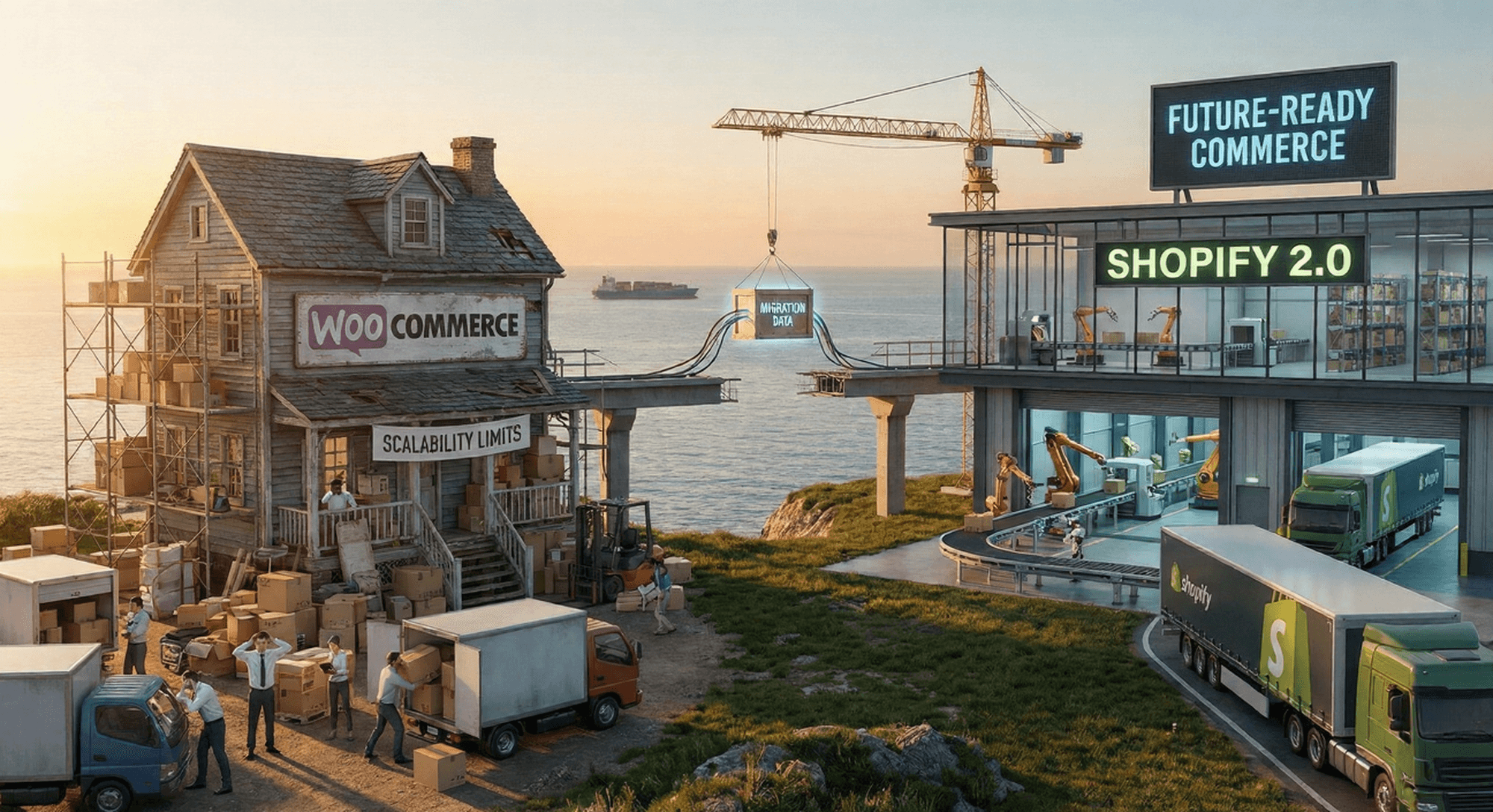
Most teams fixate on visitor counts while ignoring database strain from dynamic filtering, personalized recommendations, or real-time inventory sync. WooCommerce installations often collapse at 500+ concurrent users due to unoptimized MySQL queries, whereas Shopify 2.0’s managed infrastructure auto-scales compute resources but introduces hard limits on theme customization depth.
AI-powered search, headless storefronts, and embedded checkout flows now define baseline expectations. Platforms failing to support these without extensive engineering work create hidden scalability debt. Shopify’s native AI tools reduce implementation time by 70% versus WooCommerce’s plugin-dependent approach, but sacrifice granular control over data pipelines.
A 1-second delay during checkout costs 7% in conversions. Stores hitting WooCommerce’s scaling wall during Black Friday 2025 reported average revenue loss of $48,000 per hour of degraded performance. Shopify migrations executed proactively avoid these penalties but require 8–12 weeks of planning to prevent data fragmentation.
Shopify 2.0 eliminates infrastructure management overhead through globally distributed edge networks and automatic database sharding, whereas WooCommerce demands continuous server tuning and caching layer optimization to match equivalent uptime.
Self-hosted platforms require dedicated DevOps resources to handle traffic spikes. Common failure points include Redis cache misconfiguration causing cart abandonment spikes and unindexed product meta fields slowing category page loads beyond 5 seconds at 1,000+ SKUs. These issues compound during sales events, forcing emergency hosting upgrades that cost $15,000+ with no guaranteed resolution.
Shopify absorbs traffic surges through its CDN and load balancers without merchant intervention. During Cyber Week 2025, Shopify stores averaged 99.98% uptime versus 98.7% for self-hosted WooCommerce sites. The trade-off is reduced flexibility in checkout logic and payment gateway selection, with transaction fees applying to non-Shopify Payments gateways above $100,000 monthly volume.
Evaluation requires stress-testing your live environment against 3x peak traffic while auditing custom code dependencies against platform constraints.
Run load tests simulating 3x your highest historical concurrent users using tools like k6 or LoadView. Measure not just homepage response but critical paths: add-to-cart latency, search result speed with 50+ filters applied, and checkout completion rate under load. WooCommerce sites often fail at cart persistence beyond 300 concurrent sessions without Redis tuning.
Inventory every plugin or custom module. WooCommerce stores using Advanced Custom Fields for product options face 40–60 hours of rebuild effort on Shopify due to metafield limitations. Document which features drive revenue versus which are legacy bloat to prioritize migration scope.
Project traffic based on marketing pipeline, not past performance. If launching TikTok Shop integrations or international expansion, model 5x traffic spikes. Platforms requiring architectural changes at 2x growth create unacceptable business risk versus those scaling linearly to 10x.
Avoid a Shopify migration if your business model depends on deep payment gateway customization or ultra-low-margin transactions where Shopify’s fees erode profitability.
Businesses processing $500,000+ monthly through non-Shopify gateways like Stripe Radar for fraud control lose 0.5%–2% in additional transaction fees on Shopify. For razor-margin categories like supplements, this can eliminate 15%–30% of net profit. Retaining WooCommerce with optimized hosting preserves gateway flexibility but requires in-house DevOps.
Stores with bespoke ERP integrations writing directly to WooCommerce database tables face 200+ hours of rebuild effort on Shopify’s API-limited architecture. If these customizations drive 40%+ of revenue and lack equivalent Shopify apps, migration ROI turns negative within 18 months.
Scalater clients executing planned Shopify migrations reduced peak-season downtime to zero and increased mobile conversion rates by 18% through performance optimization.
A footwear brand migrating from WooCommerce to Shopify 2.0 achieved 55% faster mobile checkout loads by leveraging Shopify’s native image optimization and eliminating uncacheable plugin scripts. This drove a 22% lift in mobile conversion rate within 60 days post-migration, adding $380,000 in attributable annual revenue.
Twelve Scalater-managed migrations maintained 100% uptime during 2025 peak sales versus the industry average of 92.3% for self-executed migrations. Pre-migration stress testing identified and resolved cart session bottlenecks 11 weeks pre-launch, preventing an estimated $220,000 in potential lost sales per client.
Scalater embeds directly into your engineering workflow to own migration delivery with zero downtime guarantees and full data integrity validation.
Teams attempting migrations without traffic pattern analysis often trigger checkout failures during unexpected micro-spikes. Scalater implements phased DNS cutovers with real-time order validation, ensuring zero lost transactions during propagation windows through parallel order processing systems.
Platform choice determines your growth ceiling: WooCommerce demands engineering investment to scale while Shopify trades customization for reliability. Migrations are inevitable for scaling brands but must be timed before performance degradation impacts revenue. Proactive planning reduces migration costs by 60% and prevents Black Friday revenue loss. To discuss your specific scaling thresholds and migration timeline with our engineering team, reach out directly.

How to design event-driven middleware that connects e-commerce and clinical systems with queues, retry logic, and HIPAA-safe data boundaries.

Article Summary Most teams run A/B tests but see negligible conversion lifts because they test random elements without strategic grounding. This guesswork wastes development cycles and misses high-impact opportunities while competitors systematically optimize their funnels. Strategic A/B testing for CRO replaces intuition with evidence by anchoring every experiment in user behavior data and clear business … Continued


Boost conversions by 15-30% using neuromarketing principles in your CRO workflow to address subconscious emotional drivers and fix stagnant conversion rates.