Telehealth
Where Patient Data Leaks in HIPAA App Development
HIPAA compliant app development fails where no one audits. See where patient data leaks (push alerts, logs, analytics SDKs) and how to stop it.


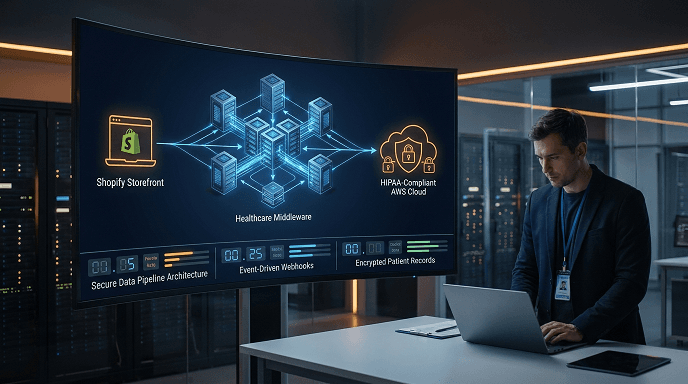
Connecting an e-commerce storefront to a clinical or pharmacy system directly creates a brittle, non-compliant coupling. The transactional system and the clinical system have different data models, different failure modes, and different regulatory requirements. Event-driven middleware solves this by sitting between them: it captures events, transforms and validates payloads, enforces a secure boundary, and routes messages through a queue with retry logic so nothing is lost. This guide walks through the architecture patterns, the implementation workflow, and the pitfalls, using a Shopify-to-pharmacy integration as the running example.
Healthcare integrations need a dedicated middleware layer because direct connections between transactional and clinical systems cross compliance boundaries and lack the fault tolerance that regulated workflows require.
Teams often assume a storefront can push orders straight into a clinical or pharmacy system with native API calls. That breaks the moment the workflow needs patient verification, insurance routing, or controlled-substance checks. Middleware separates commerce logic from clinical processing, so the transactional system never stores Protected Health Information while the pipeline stays clean and auditable.
Regulation is tightening around data transparency and shipping accuracy. Regulators increasingly expect real-time tracking and immutable audit trails. Legacy batch-sync jobs cannot meet that standard, which makes event-driven design a compliance requirement rather than a nice-to-have.
Manual handoffs between systems cost operations teams 12 to 18 hours weekly in administrative overhead. Worse, routing errors raise abandonment rates by up to 24 percent. A middleware layer removes that cost by automating transformation, enforcing validation, and giving support teams instant status visibility.
Event-driven architecture outperforms point-to-point integration by replacing scheduled polling with instant webhook triggers, so events move through the pipeline without latency or manual oversight.
Traditional integrations poll an API every 15 or 30 minutes to check for new records. Polling creates delays, overwhelms downstream dashboards at peak, and runs into rate limits. When a call fails silently, records sit in limbo, which in a clinical context directly impacts patient care and inventory accuracy.
A middleware layer intercepts an event the moment it occurs. It validates the payload, transforms fields to match the destination schema, and pushes the message through a secure queue. This guarantees immediate intake, maintains strict data separation, and scales horizontally as volume grows without changing either system’s core code.
Implementing an event-driven sync follows a sequential workflow: secure webhook registration, queue-based message routing, then automated status reconciliation.
Register the source system’s webhooks (for the example, Shopify order and fulfillment events) pointing to your middleware endpoint. Define a strict field-mapping matrix that translates source objects into destination-compliant records. Strip all non-essential PII before transmission and apply HIPAA-compliant encryption to the payload.
Route incoming payloads into a message queue such as AWS SQS or Redis. Configure exponential backoff for failed downstream responses. If a message fails after the maximum retry threshold, push it to a dead-letter queue for manual review instead of dropping it silently.
Have the middleware listen for downstream status callbacks. Map status codes (dispensed, shipped, delayed) back to the source system’s order timeline. Use standardized tracking formats so customer-facing views update automatically without manual imports.
A dedicated middleware layer is not the right call for low-volume workflows processing fewer than 50 events monthly, or for catalogs with no clinical routing at all.
Under roughly 50 monthly transactions, the infrastructure overhead of a sync layer is not justified. Manual processing stays faster and cheaper until volume consistently triggers rate limits or audit requirements.
Brands selling only non-prescription products without dosage verification or clinical routing do not need complex integration architecture. Standard shipping workflows and basic 3PL integrations handle those cases more efficiently.
Teams that move from manual handoffs to event-driven middleware see consistent gains in speed and compliance accuracy.
Moving from manual entry to automated webhook routing has produced a 30 to 40 percent drop in abandonment in pharmacy deployments. Real-time status sync gives customers immediate confirmations, which correlates with better adherence.
Partners handling seasonal spikes previously lost up to 8 percent of events during throttling. Queue-based retry and dead-letter routing have eliminated silent failures across active engagements.
Adding a new downstream partner or switching providers used to require weeks of redevelopment. A modular middleware approach reduces integration timelines to under three weeks while keeping BAA-compliant data handling.
Scalater delivers hands-on middleware deployment that removes integration risk and keeps regulated workflows secure from day one.
Teams on spreadsheet tracking or manual dashboard updates hit hard bottlenecks as volume grows. Without structured automation, audits fail, support drowns in status inquiries, and latency erodes trust.
Internal teams tend to underestimate the complexity of mapping clinical schemas, executing secure BAA workflows, and handling cross-system webhook failures. That leads to incomplete syncs, silent data loss, and expensive rework.
Scalater embeds execution teams into your sprint cycles to build and validate the middleware alongside your engineers. For time-bound launches we deploy dedicated pods that own the full integration scope from architecture design through production monitoring, with fixed-scope, transparent deliverables and no advisory-only handoffs.
Reliable integration architecture hinges on decoupling systems, routing through a queue with retry, and enforcing compliance boundaries from day one. If your current process relies on manual routing or direct polling, the operational risk compounds as volume increases. To see where your integration gaps are and map a secure path forward, reach out to our team to book a free consultation.

HIPAA compliant app development fails where no one audits. See where patient data leaks (push alerts, logs, analytics SDKs) and how to stop it.

Choosing a white label telehealth platform depends on your use case. Compare 6 networks, pricing, and compliance rules before you sign.


Telehealth app development runs $40k to $250k across the market. See what really drives your price, timeline, and HIPAA-ready build before you commit.
